Unlocking More Range:
How TEC's Smart Balancing
Gives EVs the Edge
Traditional balancing only kicks in at full charge — leaving hidden cell imbalances to quietly steal your kilometres. Here's how we fixed that.
Your EV battery might be losing range every day — silently
Think an EV's range is purely about chemistry and kilowatt-hours? The real story is subtler. Beneath the hood, the way individual battery cells are managed and kept in sync makes a larger difference to real-world range than most people realise.
A battery pack isn't a single unit — it's hundreds or thousands of individual cells working together. When they drift out of alignment, the whole pack underperforms. And the method most EVs use to fix this only activates at 100% charge — a threshold most owners rarely reach.
A rowing team in sync — versus one that isn't
Think of a battery pack like a rowing team. When every rower pulls at exactly the same rate, the boat glides. One off-beat rower and the whole crew works harder for less speed. Battery cells work identically — balanced cells mean more range, more power, and smoother performance. Imbalanced cells mean wasted energy and degraded output on every journey.


LFP batteries need a smarter touch
LFP (Lithium Iron Phosphate) batteries dominate India's EV market — safe, long-lived, and well-suited to extreme heat. But they come with a specific challenge: their voltage changes so little during charge and discharge that conventional balancing algorithms simply can't see when cells drift apart.
Traditional voltage-only balancing misses these silent differences entirely. Add the fact that most EV owners rarely charge to 100% (the slow final stage discourages it), and the result is a system that balances infrequently — if at all. Imbalance accumulates. Range slips away. Owners assume it's just battery ageing.
Understanding where capacity is actually lost
Not all capacity loss is equal. Some is recoverable through better balancing — and some is permanent. Understanding the difference is the first step to acting on it.
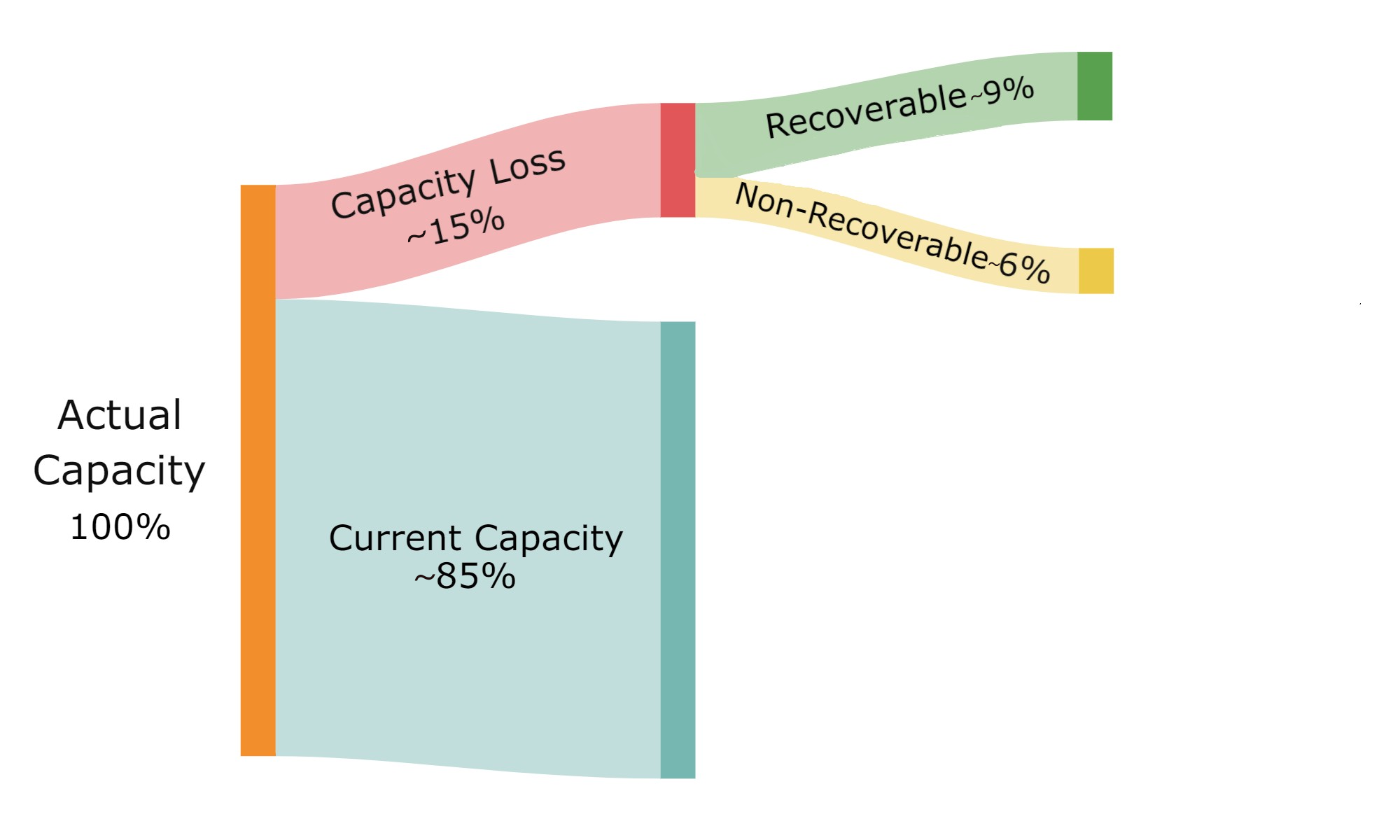
By distinguishing between Current Capacity, Recoverable Capacity Loss, and Non-Recoverable Loss, TEC's algorithm targets the recoverable portion — actively managing and restoring what's possible, while flagging cells heading toward permanent degradation.
Four ways cells quietly fall out of balance
How TEC addresses each one
- Cell matching at assembly — meticulous sorting ensures cells with similar characteristics are paired from day one
- Tight thermal management — every cell ages at the same rate when every cell runs at the same temperature
- Smart detection algorithms — self-discharge and resistance changes are identified in real time, not at the next service interval
Why TEC's algorithm leaves conventional balancing behind
Conventional CV balancing waits for a full charge to do its work — a passive, infrequent approach that leaves cells to drift unchecked between sessions. Manual rebalancing at service centres is the fallback: costly, time-consuming, and reactive by nature.
| Method | How it works | Range impact | Service needed | Cost |
|---|---|---|---|---|
| Old-School CV Balancing | Passive, activates at 100% only | Declines over time | Regular | Medium |
| CV + Manual Service | Adds periodic rebalancing sessions | Okay, with downtime | High | High |
| TEC Dynamic Algorithm | Active at all SOCs, charging, discharging, rest | Maintains max range | Minimal | Low |
| TEC Full Stack (Pack + BMS + Cloud) | Fully integrated, data-driven, fleet-aware | Every km recovered | Near zero | Lowest |
The key differences: TEC's balancing is always on — working during charging, discharging, and at rest. It corrects in real time rather than waiting for trouble. And it incorporates cell temperature and age into every decision, so the algorithm adapts to each cell's individual behaviour, not a population average.
36 months of data. The difference is measurable.
A 36-month longitudinal study compared three real-world balancing approaches across equivalent battery packs. The results are unambiguous.
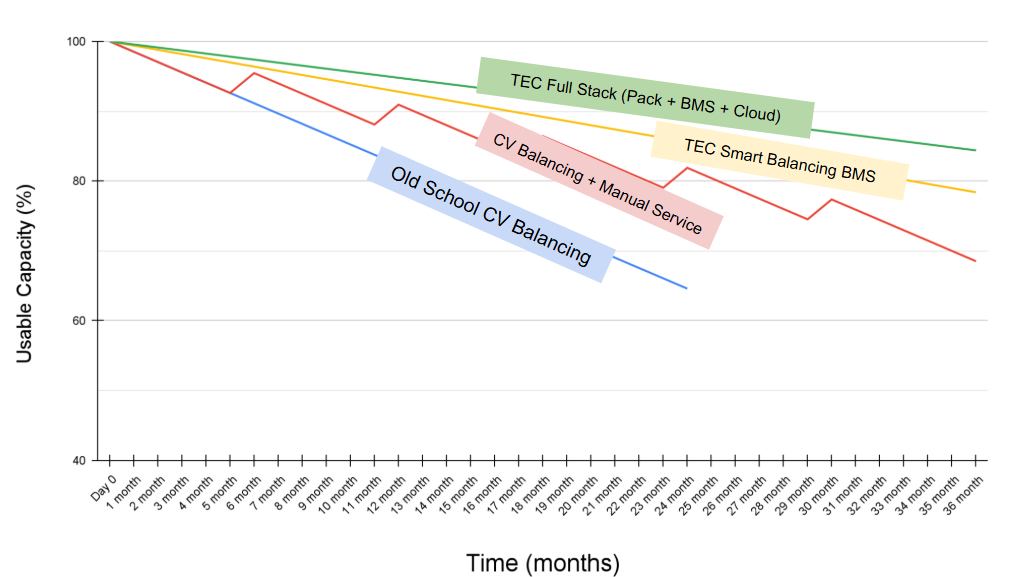
Battery capacity retention over time — comparing balancing methods
Current methods saw the fastest health decline — lost range and increasing service frequency from month 12 onwards. Periodic manual service improved things marginally but required repeated interventions and still showed performance cliffs. TEC's smart algorithm maintained over 15% more usable battery energy at the 34-month mark — with no manual rebalancing and no sudden drop-offs.

